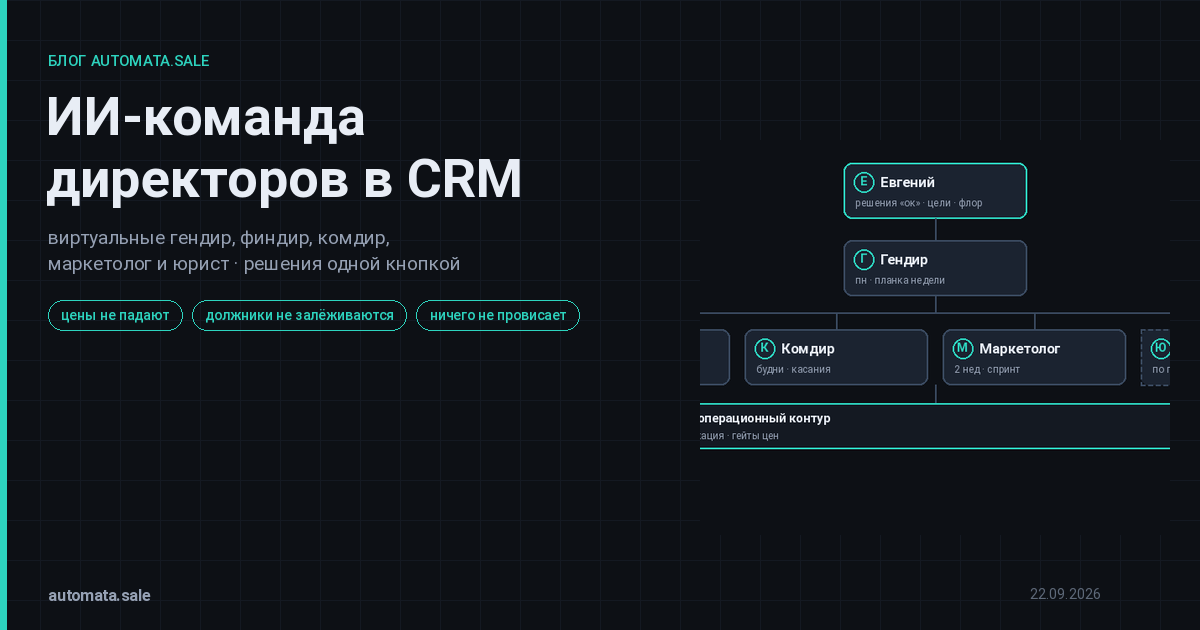
Structured Answer: An AI board of directors is a set of specialized AI roles — CEO, CFO, sales lead, marketer, lawyer — that run on top of your CRM data on their own schedule: they track revenue against targets, watch accounts receivable, catch silent customers, draft messages and ask the owner questions with pre-built answer options. The key mechanism is gates: the system physically cannot send a client a price below the approved floor or a discount above the threshold, and every decision passes through a human with one click on the dashboard. For a small business, this replaces executives it cannot afford to hire — and compensates for the typical weak spots of an expert-owner: underpricing, patience with late payers, and postponed uncomfortable decisions.
We have written before about our CRM becoming a chat and about an agent that creates clients and tasks from a single phrase. One role was missing: not collecting information, but helping make decisions. That’s how a virtual board of directors appeared in the CRM.
Why a small business needs a virtual board
The typical picture: the owner is a strong expert — developer, lawyer, marketer — but not a manager. Prices get discounted, because asking for more feels awkward. Debtors stretch on for months, because “he’s a decent guy, he’ll pay”. Strategy gets postponed, because operations and inbox eat every day. Hiring a CFO or a sales director is not an option at this scale.
We solved it the same way we solved everything else in this system: if an AI agent can do the routine, let it do management routine too. Not “AI makes the decisions” — a team of assistants that prepares decisions and doesn’t let the owner drift.
Who sits on the board
Each role is not a chatbot with a name, but an agent with its own area of responsibility, data sources and schedule:
| Role | What it does | When it runs |
|---|---|---|
| 🎯 CEO | weekly plan: 3 priorities, the day’s red list, a “planned vs earned” review | Monday morning |
| 💰 CFO | revenue vs target, receivables, top costs, per-tarif unit economics; the pricing gate | Friday evening |
| 📞 Sales lead | touches: sleeping clients, unanswered leads, debtors on schedule | weekdays, before the day starts |
| 📝 Marketer | content sprints: articles, SEO/GEO, cross-posting, lead gen | every two weeks |
| ⚖️ Lawyer | contract checklists, pre-legal claims, correspondence records | on demand, when a rule fires |
Below them sits the operational layer: an assistant that collects email and messengers every 15 minutes, triages inbound messages and answers routine questions. The executive roles read the same data on top of that layer.
The “Board” dashboard: decisions in one click
The team’s home screen is a dashboard tab. At the top: goals progress, receivables, the day’s red list. Below: the org chart — who reports to whom, who reads what, who produces what. But the centerpiece is the question queue.
Every role’s report ends not with “conclusions” but with a concrete question to the owner, with answer options:
CFO: “Client X hasn’t paid in three weeks. Remind them today or wait until month-end?” — [a] remind today, show me the draft — [b] wait until month-end — [c] prepare a formal demand
The owner clicks a button — the decision is recorded, the role proceeds. The whole board fits into a couple of minutes a day: between other things, from a phone, no meetings.
Gates: a system that argues with the owner
The value is not in reports but in rules that politeness cannot bypass. We call them gates:
- The price floor. Minimum rates per service are fixed in the company charter. A quote below the floor or a discount above the threshold physically cannot go out — it turns into a question to the owner with a margin calculation.
- Receivables escalation. D+7 — polite reminder, D+14 — formal demand, D+30 — legal claim. The schedule doesn’t slip and doesn’t freeze on step one: stages arrive by calendar, not by mood.
- “Quote first, code later.” Development without an approved quote is flagged as a process violation, and the CEO calls it out.
Gates exist precisely for the decisions humans postpone. AI has no awkwardness.
How a decision flows
To keep the structure visible, the dashboard carries a “how a decision flows” diagram:
Role prepares a verdict → Journal → Question with buttons → Owner’s “ok” → Execution
Every verdict lands in a journal, so the team accumulates a management history: what was advised, what was decided, how it ended. A quarter later that’s ready material for a retrospective: which CEO decisions made money, and which didn’t.
A human stays in the loop everywhere money and commitments are involved: the assistant freely answers client questions, but promises of work, deadlines and pricing only happen after the owner’s “ok”.
What a business gets
- Pricing stops sliding. The floor is fixed in numbers, not in a feeling of “well, fine, a small discount”.
- Debt doesn’t rot. The escalation calendar runs itself; the owner approves texts but doesn’t have to initiate each step.
- Nothing dangles. The daily red list and touches on sleeping clients mean: if a client has been silent for a week, the system remembers first.
- Decisions take minutes. A question arrives with options — a button is clicked — the team executes.
- A decision log. The verdict journal is an audit trail of management decisions, which small businesses almost never keep.
The system runs on our own live data. A setup like this — roles, rituals and gates tuned to the specific weak spots of a specific business — is assembled per task: if you want a virtual CFO who won’t let you discount your way into the ground, write to us and we’ll show how it works.
📞 +7 (906) 311-77-69 · ✉ hello@automata.sale · 💬 Telegram: @automatasale